
Last updated October 30, 2026
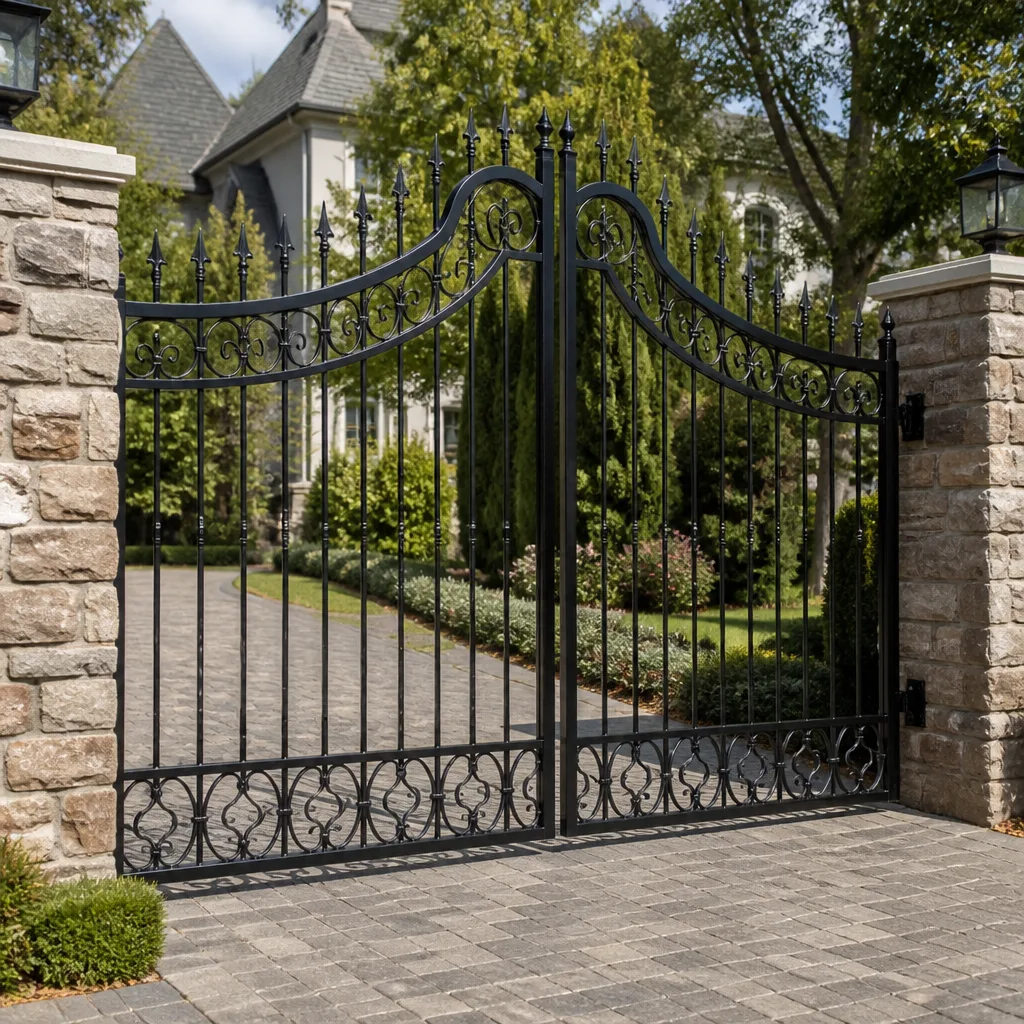 Wrought iron
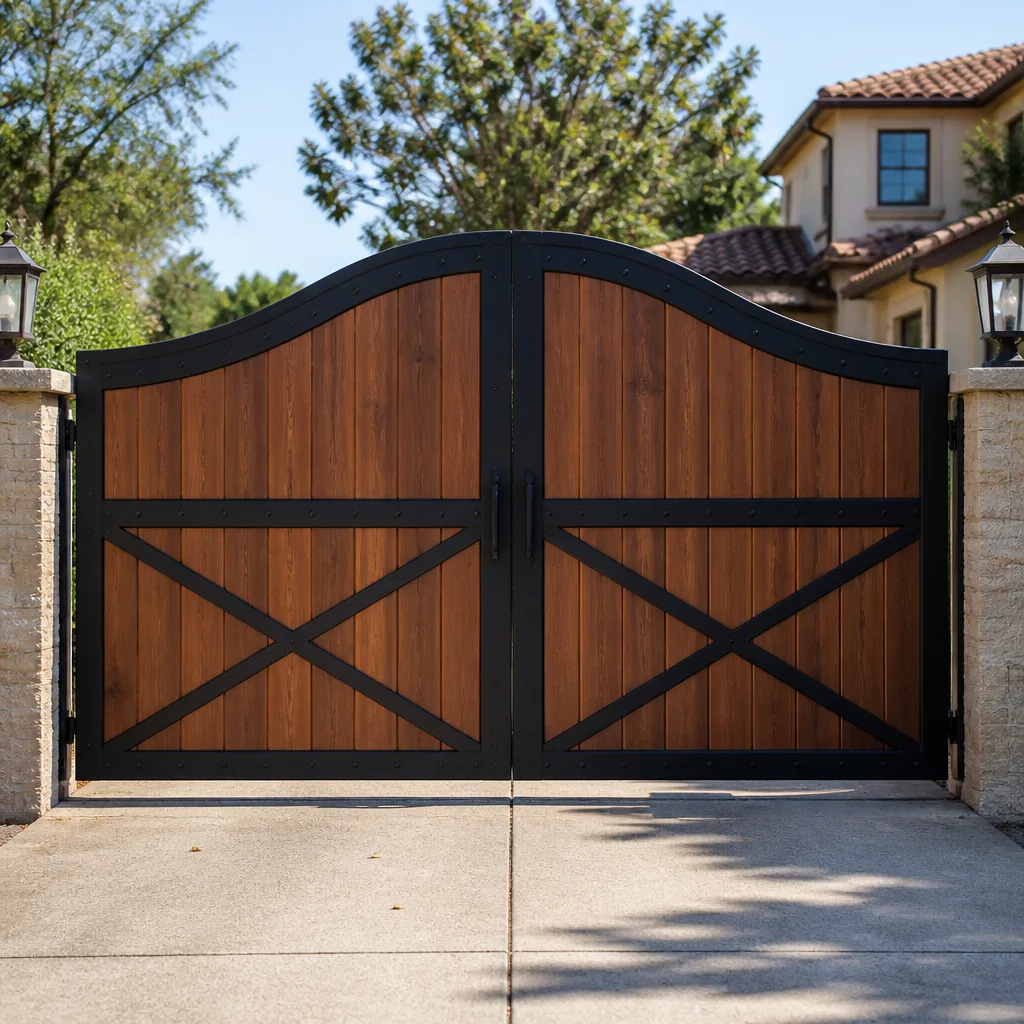 Wood & steel frame
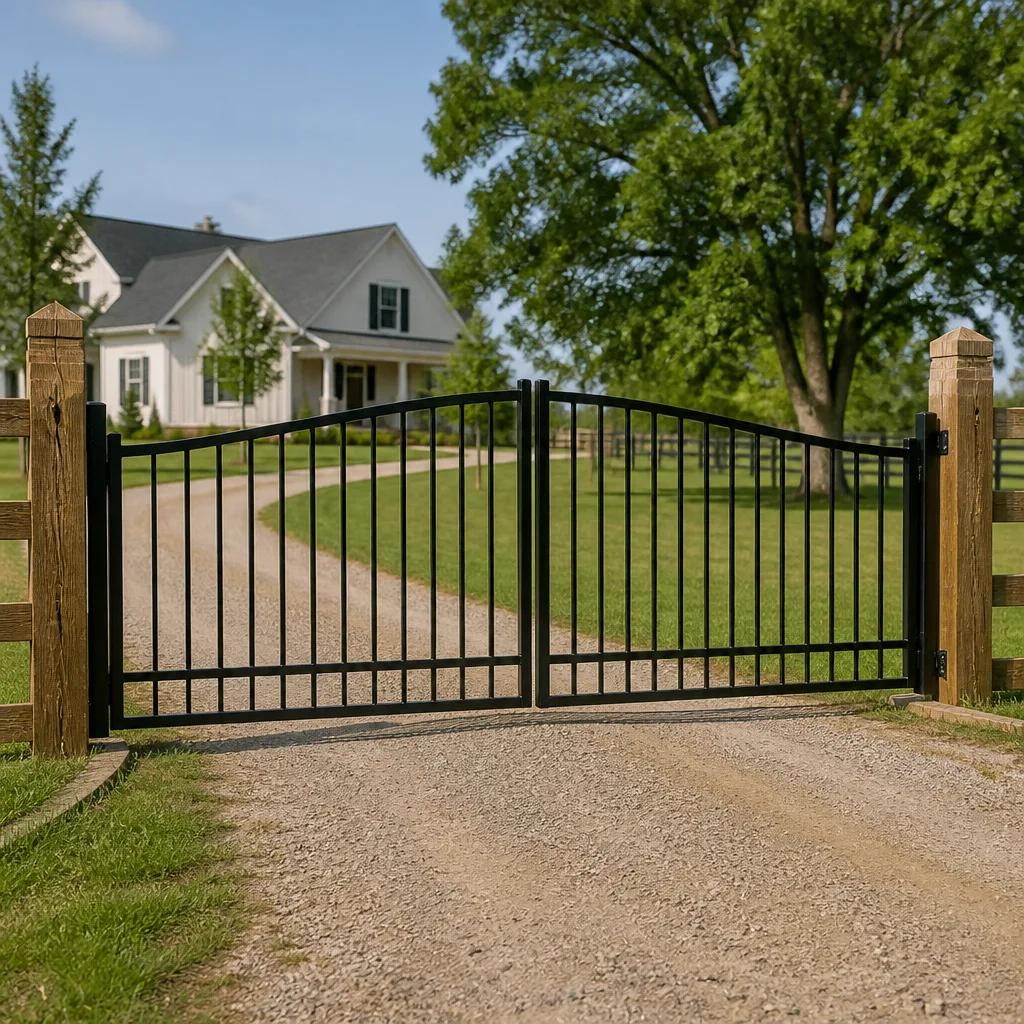 Farm & ranch
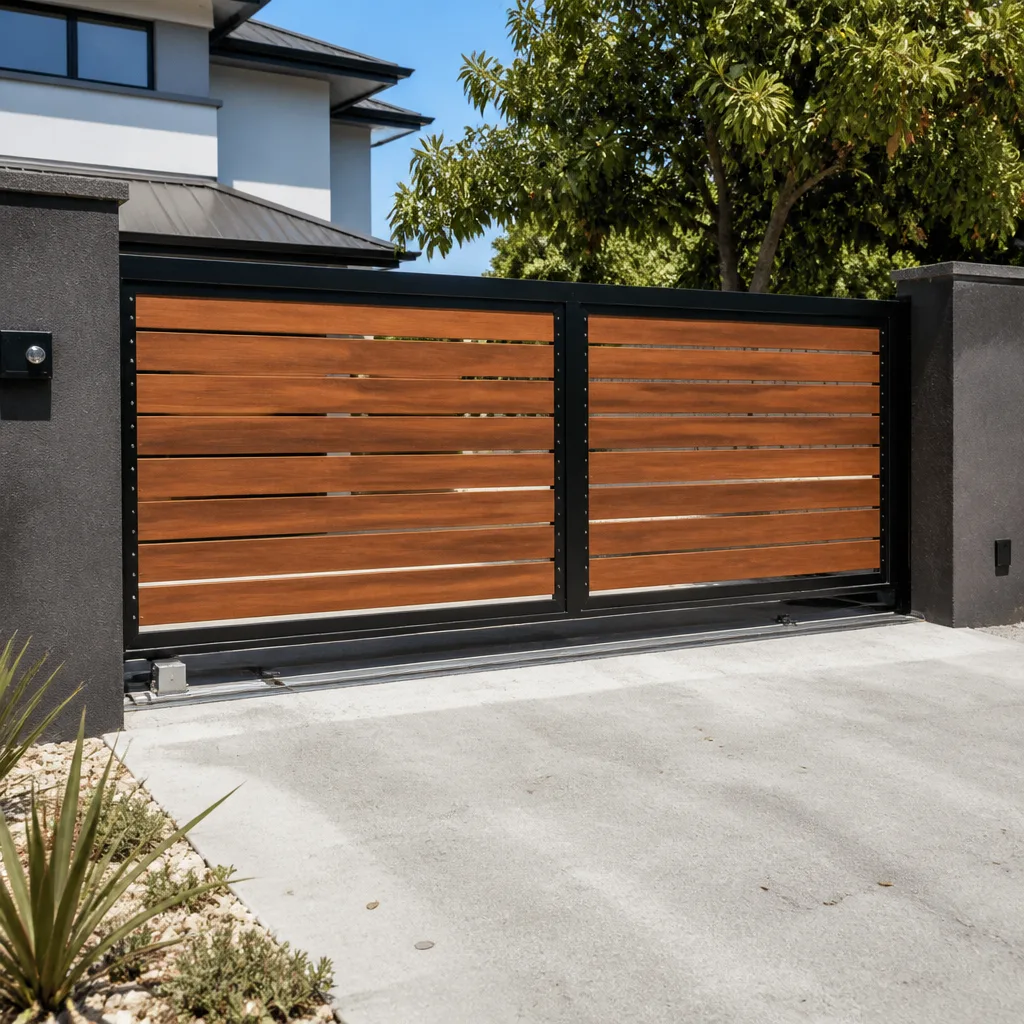 Sliding driveway gates
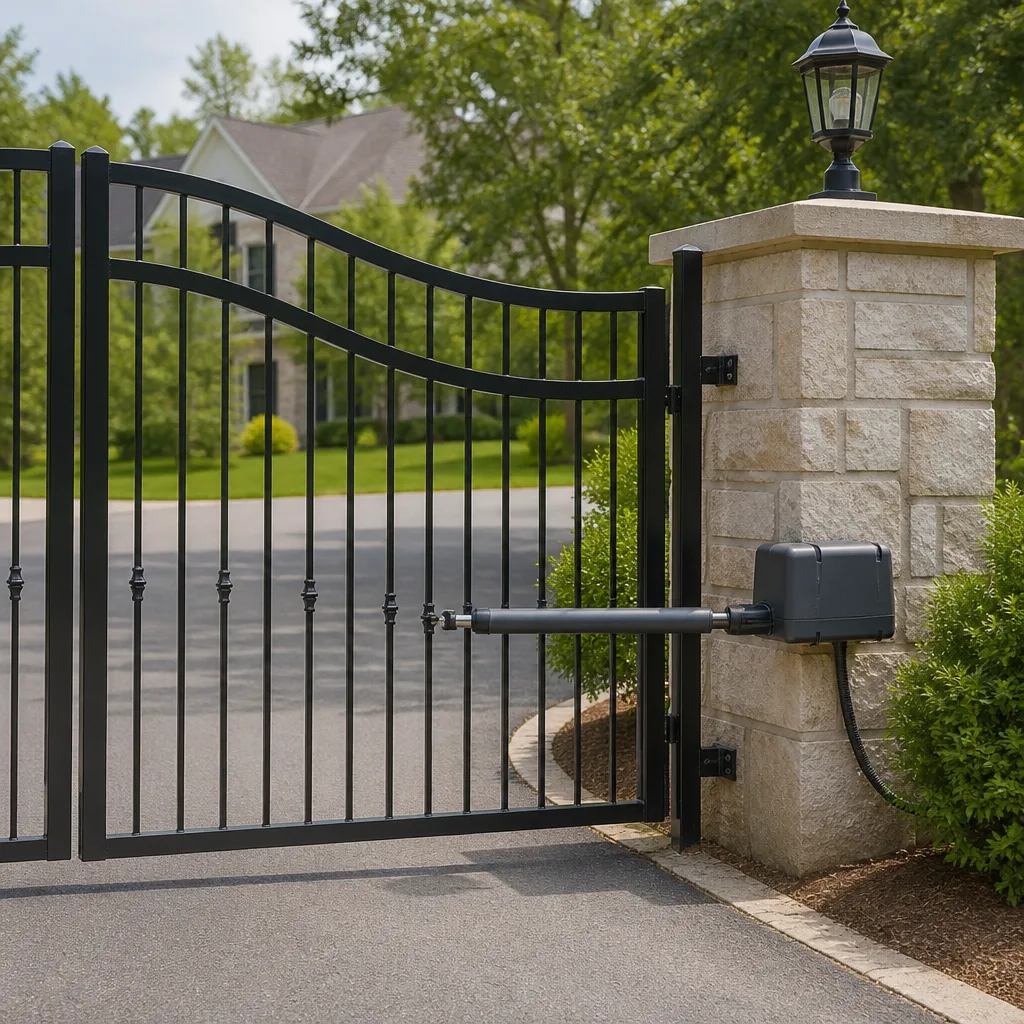 LiftMaster operators
Free on-site gate assessment - hinges, posts, and your LiftMaster or Nice gate operator checked before anything is quoted
The assessment is free and the quote is the invoice.
Get your free estimateThe Complete Guide to Gate Repair in West Palm Beach
Most gate repair work in West Palm Beach is not done by the first company that looked at the gate. It is done by the second. That is not a criticism of the first company. It is a statement about how South Florida conditions mislead even experienced technicians. Salt air, afternoon storms, high water tables, and a coastal climate that never really cools down create failures that look mechanical on the surface but are actually electrical, corrosion-driven, or alignment-related underneath. This guide exists to give property owners in West Palm Beach the diagnostic framework they need to understand what is actually wrong with their gate, what a proper fix looks like, and how to avoid paying for Gate Repair services that fail again in six months. We will walk through system types, failure modes, cost drivers, storm damage, and the legal landscape around who can legally work on what in Florida.
Styles & brands we work with
Quick Answer
Gate repair in West Palm Beach starts with correctly identifying the system type and failure mode, because coastal corrosion, electrical surges from storms, and shifting ground from seasonal rain each produce distinct problems that require different repair approaches. Most repeat failures are caused by fixing the symptom instead of the root cause. A proper repair restores full function, addresses the underlying condition, and includes verification of all safety systems, not just the part that stopped working.
Table of Contents
- Gate System Types Common in West Palm Beach
- How Salt Air and Humidity Actually Damage Gate Components
- Failure Patterns by System Type
- Storm-Related Gate Damage: Why It Is Misdiagnosed
- Repair vs. Restore: What Your Quote Is Actually Offering
- Florida Licensing: Who Can Legally Work on Your Gate
- What Gate Repair Costs in West Palm Beach
- Common Mistakes to Avoid
- When to Call a Professional
- Frequently Asked Questions
- The Bottom Line
Gate System Types Common in West Palm Beach
West Palm Beach properties run four main types of automated gate systems, and each one fails in a distinct way. Knowing which type you have is the fastest route to understanding what a repair should involve, because a slide gate with a bad limit switch and a swing gate with a bent hinge are entirely different jobs that happen to share a symptom: the gate will not open.
Slide gates move horizontally along a track and are the most common on mid-size to large residential and commercial properties in West Palm Beach. They are popular because they do not require the large arc of open space a swing gate demands. The tradeoff is that their track, rollers, and cantilever supports sit close to the ground, where sand, landscaping debris, and standing water from summer downpours accumulate. Failures typically start as increased motor strain, not sudden stoppage. The operator is working harder before it fails completely.
Swing gates pivot on hinges and are favored for shorter driveways and properties where the gate is primarily a visual statement. In West Palm Beach, the two ongoing threats are wind load and hinge corrosion. A swing gate catches wind like a sail during storms, and every stress cycle is transferred through the hinge plates into the post. Over time, the post shifts, the gate sags, and the operator’s torque setting gets pushed past its limits. The operator fails, but the gate was failing first.
Vertical pivot gates rotate upward and are common on commercial facilities, storage yards, and industrial lots. They require precise counterbalance, and when the balance changes due to rust or wear, the operator must bear the full weight of the panel. We see operator burnouts on vertical pivots that were properly balanced a decade ago and never re-checked. Barrier arm gates are the last common type and are primarily commercial. Their failure modes are almost entirely electrical, involving loop detectors, control boards, and sensor alignment, rather than mechanical wear on the arm itself.
Regardless of system type, the repair logic is the same: identify the system, locate the actual failure point, and fix the cause, not just reset the symptom. That approach is the foundation of the work covered on our Gate Repair in West Palm Beach page.
How Salt Air and Humidity Actually Damage Gate Components
Coastal South Florida is not hard on gates the way the desert is hard on engines. It is slower and more corrosive. Two forces work together: salt aerosol from the Atlantic and persistent humidity that stays above 70 percent for most of the year. Together, they penetrate enclosures, condense on circuit boards, and accelerate galvanic corrosion between dissimilar metals. Inland Florida properties, even those 20 miles west of I-95, do not experience the same rate of component decay. This is a West Palm Beach-specific operating condition that changes repair economics.
Motor brushes wear faster in this environment. Brushes are carbon blocks that transfer current to the motor’s commutator. Salt accelerates the creation of a conductive dust film inside the motor housing, which creates micro-arcing that erodes brush faces and commutator bars faster than in dry climates. A motor that would last eight years in Orlando may last five in a coastal West Palm Beach neighborhood. The symptom is a gate that starts slowly, then intermittently, then not at all.
Control boards suffer from two distinct failure modes here. First is creeping corrosion on solder joints and IC pins. Humidity condenses inside the control box at night as temperatures drop, and the resulting moisture film, combined with trace salt, grows corrosion that eventually bridges adjacent circuits or breaks a connection entirely. Second is storm surge and lightning-induced ripple on the board’s input stage. The first mode looks like age. The second looks like sudden death. Proper diagnostics can tell them apart by inspecting the board’s power supply section before recommending replacement.
Hinges, particularly steel-on-steel or steel-on-bronze combinations, fail from crevice corrosion. Salt builds up inside the hinge barrel where oxygen is depleted, creating an acidic micro-environment that eats the pin from the inside. The gate looks fine from the outside. It moves smoothly by hand. Then it begins to drag, and the operator cycles more often, and the motor burns out. The hinge was the root cause, not the motor.
This is why repair work in West Palm Beach should always include a corrosion assessment of the parts you cannot see. If you want to understand the full scope of what climate-driven failure looks like, our Electric Gate Repair in West Palm Beach guide covers motor, board, and access system failures in detail.
Failure Patterns by System Type
Each gate system fails in a recognizable pattern once you know what to look for. Here is how to read the signs on the four most common systems in West Palm Beach.
- Slide gates fail through track fouling and motor strain. Watch for slowing at specific points along the track, a grinding sound when the bearing wheels pass a given section, or a gate that stops and reverses more than once per cycle. Those signs indicate the operator is fighting debris, corrosion on the rail, or failing bearing wheels. The fix is clearing the track, repairing or replacing wheels, and then resetting the operator’s force settings. Replacing the motor without clearing the track guarantees the new motor dies early.
- Swing gates fail through hinge wear and post movement. Signs include a visible sag at the latch end, uneven gap at the bottom, and a motor that hums but does not move the gate. Check hinge play first. Lift the gate at the latch end; any movement at the hinge pin means the mechanical system is worn. The repair is hinge replacement or post reset, sometimes both, before re-mounting the operator and checking its limit settings.
- Vertical pivot gates fail through lost counterbalance. If the gate was balanced at installation, it should hold at any point in its arc. When it does not, the springs or weights have changed. A repair that installs a larger operator to force the gate through its travel is treating the symptom. The proper fix is rebalancing, then operator adjustment.
- Barrier arm gates fail through their electronics. Loop detectors are the most common point of failure, followed by worn relay contacts in the control board and misaligned safety sensors. Since these gates cycle hundreds of times daily in commercial settings, even a small electrical fault causes visible problems fast. The repair is component-level replacement and sensor re-alignment, not arm welding.
Some brands fail more gracefully than others. Linear operators, for example, tend to chew limit switches slowly and give clear warning. Viking boards typically fail in their power stage after electrical events. Ghost Controls systems, common on residential DIY installs, are straightforward to diagnose because their wiring is simpler, but their connections can be the weak point in West Palm Beach humidity. DoorKing systems are dense but robust, and many of their failures are age-related on equipment that is 15 years or older. None of these brands are unsupported at our shop. We work on the brand you already have, not just the one we sell.
Storm-Related Gate Damage: Why It Is Misdiagnosed
When a gate stops working after a storm, most property owners assume something was physically broken by wind. That is sometimes true. More often, the actual damage is electrical or alignment-related, and misdiagnosing it leads to replacing parts that were never the problem.
Wind is the least common culprit. Gates are designed for wind load. What wind does is push a swing gate against its stops, or push a slide gate into its end catch, transferring stress into the mounts and posts. The visible damage may be slight, but the alignment has shifted enough that the operator’s limits are now wrong. The gate then slams, reverses, or stalls. A technician who replaces the operator has fixed nothing forever. The posts must be re-aligned, hinges checked, and limits reset.
Electrical damage is more subtle. A nearby lightning strike does not need to hit the gate directly. It induces voltage spikes on the low-voltage loop detector wiring, which runs underground along the driveway. Those spikes kill the loop detector first, then the control board input. The gate may power on but not respond to vehicles, or it may respond intermittently when the board is cool and fail when it warms up. That is a classic sign of component-level electrical damage, and it requires board inspection, not motor replacement.
Water is the third factor. West Palm Beach downpours can dump three inches of rain in an hour. If the gate’s junction boxes are not properly sealed, or the control enclosure has a degraded gasket, water gets in and shorts a connection. The gate fails during or immediately after the storm, then may revive days later when things dry out. That is the signature of a moisture ingress problem. Left unfixed, it corrodes the wiring and the board until the gate fails permanently.
Diagnosing storm damage properly means checking the electrical system first, alignment second, and visible mechanical damage third. The correct sequence changes the cost and the outcome. If you had a storm-related failure, the repair offered should include a full mechanical and electrical assessment, not just a part swap on the most obvious component.
Repair vs. Restore: What Your Quote Is Actually Offering
There are two kinds of gate repair, and you cannot tell them apart by price alone. The difference is what happens to the gate over the next 12 months.
A repair that restores function fixes the part that stopped. If the capacitor failed, the capacitor is replaced. The gate opens. Invoice closed. Nothing else was checked. This is not inherently dishonest work. It is incomplete work. In West Palm Beach, where corrosion is slow and relentless, an incomplete repair often holds for six to eight months, then something else fails, usually a component that was already degrading when the first part gave out. The property owner then pays for a second service call and begins to wonder if gate repair ever actually solves anything.
A repair that restores reliability fixes the part that stopped and then examines every component connected to it. The technician checks the motor’s current draw at full load, tests the battery backup, inspects the board for corrosion patches, verifies loop detector sensitivity, checks hinge play, and resets safety sensor alignment. That kind of repair produces an invoice that lists more than one line item, but it produces a gate that does not call back in six months. We call this Sovereign-standard work: complete solutions, not temporary patches.
You can tell which kind of quote you have by asking three questions. First: “What caused the failure?” A complete answer names the root cause. A vague answer says the part was bad. Second: “What else is at risk right now?” A real technician will point to specific components and tell you their condition. Third: “What happens if I do only the minimum?” If the answer is “the gate will work,” that is a function restore. If the answer includes what else might fail and when, that is a reliability quote.
A gate that fails again is not a repair. It is a callback. The difference between the two approaches is usually not a large sum of money. It is the diagnostic time the technician was willing to spend looking for what is not yet broken.
Florida Licensing: Who Can Legally Work on Your Gate
Florida law draws a specific line between what a property owner can do on their own gate and what requires a licensed contractor. That line is important, because crossing it without the right credentials creates liability for the owner, not just the person turning the wrench.
Under Florida Statute 489, the installation, repair, and modification of automated gate systems that involve electrical connections to line voltage, low-voltage access control wiring, or safety device installation falls under the scope of licensed electrical or specialty structure contractors. The key word is automated. A purely manual gate, one with no operator motor or access system, is treated differently than an electric gate. The moment a motor, control board, photo-eye, or loop detector is involved, the work is governed by building codes that reference electrical safety, UL 325 compliance, and entrapment protection standards.
What a homeowner may legally do on their own property is limited to routine maintenance that does not alter or repair the system: greasing hinges that have grease fittings, clearing debris from the track, tightening exposed bolts that are visibly loose, and cleaning photo-eye lenses. What a homeowner may not legally do, despite what YouTube suggests, is wire a new control board, replace a motor capacitor, install a loop detector, or splice low-voltage access control wiring. Those tasks involve hazards that are not obvious to someone who has not been trained, including stored energy in capacitor circuits and entrapment protection that, if wired incorrectly, can cause serious injury or death.
We include this section because a significant number of gate failures we see in West Palm Beach are the result of attempted DIY electrical repairs that made the original problem worse. If the repair involves opening a motor housing, touching the control board, or altering wiring, it is time to call someone whose job is knowing how these systems fail and how to fix them correctly.
What Gate Repair Costs in West Palm Beach
Gate repair pricing is one of the hardest things for property owners to compare, because two repair quotes may describe the same gate problem in completely different terms, as detailed in our Gate Repair Cost Breakdown: The West Palm Beach Homeowner’s Reference for 2026. Here is how to think about what you are paying for.
Most residential gate repairs in West Palm Beach fall into three bands. The first band is component replacement: capacitors, limit switches, remote controls, photo-eyes, and battery backups. The second band is board and motor work: control board replacement, motor rebuild or swap, and loop detector replacement. The third band is mechanical and structural: hinge replacement, post resetting, track repair, and operator mounting. Commercial barrier arm and vertical pivot work typically costs more because the components are heavier, the access systems are more complex, and the diagnostic time is longer.
Rather than invent a single number that pretends every repair is the same, here is what you should expect to see on a legitimate quote:
- Diagnostic visit and assessment: typically $85 to $150, applied toward the repair if approved. This is normal. A technician who quotes over the phone without seeing the gate is guessing.
- Limit switch or capacitor replacement: usually $150 to $350 including the part and labor, depending on the operator model.
- Photo-eye or edge sensor replacement: generally $180 to $400 per sensor, including alignment and safety verification.
- Control board replacement: commonly $350 to $900, depending on brand and whether it is a single board or a stacked board assembly.
- Motor replacement or rebuild: typically $500 to $1,200 for residential operators, and $1,200 to $3,500 for commercial-grade units.
- Hinge replacement or post resetting: often $300 to $800 per post, plus any required concrete work, and this varies widely with gate size and post condition.
- Battery backup replacement: $150 to $400 for sealed lead-acid systems, and more for lithium retrofit kits on newer operators.
Every legitimate repair quote should state the full price before work begins. The price is quoted and agreed before any work starts. If a company will not do that, do not approve the job. Also ask whether the diagnostic fee is applied to the repair, what warranty the parts carry, and whether the final bill includes a full safety system check. Many property owners in West Palm Beach learn the hard way that the lowest quote was low because it excluded the diagnostics that would have found the second fault. A quote that looks suspiciously cheap is usually a function-only repair. It restores movement and leaves the underlying cause in place.
Common Mistakes to Avoid
- Replacing the operator without checking the mechanical system first. A gate that has a worn hinge, sagging post, or fouled track will destroy a new motor in months. The operator is often the victim, not the culprit. Check mechanical condition before spending on electrical components.
- Ignoring intermittent failures because the gate works again on its own. In West Palm Beach humidity, intermittent problems are almost always early-stage corrosion or moisture ingress. The gate is telling you something. It will not fix itself, and waiting makes the eventual repair larger and more expensive.
- Using a handyman for electric gate diagnostics. Mechanical tightening on a manual gate is one thing. Electric gate board diagnosis, loop detector work, and safety sensor wiring are another. Florida law draws a licensing line here, and crossing it puts the property owner at risk on multiple fronts.
- Choosing parts by price rather than compatibility. Off-brand control boards and generic photo-eyes work poorly on Viking, Linear, Ghost Controls, and DoorKing systems. They create intermittent faults that are hard to trace and often fail within a year. Match the part to the system.
- Replacing instead of diagnosing the control board. A board failure has a cause: voltage spike, moisture, a shorted accessory. Replacing the board without finding the cause means replacing it again. This is one of the most common repeat-service mistakes we see on golf course communities and gated HOAs around West Palm Beach.
- Deferring battery backup replacement until the gate fails in a storm. Battery backups have a finite life, and South Florida storms test them. If the battery is older than three years or has never been load-tested, plan a replacement before hurricane season, not after the first power outage.
- Not verifying entrapment protection after a repair. Any repair that touches the operator, board, or sensors changes the safety profile of the gate. A residential gate that does not reverse when it contacts an obstruction is a liability and a serious hazard. Insist that every repair include a safety system verification.
When to Call a Professional
You should stop trying to solve the problem yourself when the gate’s symptom involves the motor, the control board, any wiring, or the entrapment sensors. Those are the systems where a wrong guess creates a safety hazard and a bigger repair bill. You should call a professional if the gate reverses for no reason, moves at inconsistent speed, hums without moving, fails after rain, or trips its breaker. You should also call if the gate was hit by a vehicle, since frame damage and post misalignment are not always visible to the eye but will cause operator failure within weeks. Sovereign Gate Repair offers free estimates in West Palm Beach, and our diagnostics cover the mechanical and electrical system as one linked failure chain. Call (855) 360-5979.
Frequently Asked Questions
Most residential gate repairs in West Palm Beach run between $150 and $1,200 depending on whether the failure is a simple component like a limit switch or capacitor, a control board, or a motor. Mechanical repairs such as hinge replacement or post resetting can push costs higher. Always get the full quote in writing before work begins, and confirm that diagnostics are included. Call (855) 360-5979 for a free estimate on your specific system.
Many component-level failures, such as limit switches, capacitors, and photo-eyes, can be diagnosed and repaired in a single visit once parts are on the truck. Board and motor failures on less common systems may require ordering the specific part, which typically takes a few days. The fastest way to know is to have the gate assessed. Estimates are free, and the price is confirmed before any work starts.
Corrosion-driven electrical failure is the most common cause, particularly on coastal properties where salt air destroys motor brushes, board solder joints, and low-voltage connections faster than mechanical wear does. The second most common cause is post or hinge misalignment that overloads the operator. Both are root-cause issues that a surface-level repair will not fix permanently.
Yes, for any work involving line voltage, low-voltage access control wiring, or safety device installation, Florida law requires a licensed contractor under the relevant specialty or electrical classification. Homeowners may perform basic maintenance like cleaning tracks and tightening visible bolts, but electrical diagnosis and repair should be left to a qualified professional. The liability for improper work on an automated gate is substantial.
We work on the brand you already have. Our technicians are factory-familiar with Linear, Viking, Ghost Controls, DoorKing, LiftMaster, FAAC, BFT, Elite, and Mighty Mule, spanning residential and commercial systems. An older gate does not necessarily need replacement. In many cases the failure is a serviceable component, and a proper diagnosis can extend the life of the system you already paid for.
A full repair includes diagnosis of the actual failure point, a written quote before work begins, replacement or repair of the failed component using compatible parts, checking of connected components for early-stage failure, and a complete safety system verification including entrapment protection. We treat every job as a complete solution, not a patch, because a gate that fails again is not a repair. Call (855) 360-5979 to schedule a free estimate.
The Bottom Line
Gate repair in West Palm Beach is a climate-specific discipline. The gate systems themselves are not unique to South Florida, but the way they fail is: salt air eats motors and boards, humidity feeds corrosion in hidden enclosures, and storms induce electrical damage that looks mechanical. A proper repair identifies the system type, locates the true failure point, and fixes the cause rather than the symptom. Ask for a diagnostic before approving work, require the full price in writing, and do not accept a quote that replaces parts without explaining why they failed. For a free estimate and a repair that restores reliability, call (855) 360-5979. For more on what separates surface-level fixes from lasting repair work, visit our Sovereign Gate Repair home page, or read our detailed guides on Gate Installation in West Palm Beach and Electric Gate Repair in West Palm Beach.
Written by the team at Sovereign Gate Repair, serving West Palm Beach since 2015. Explore more guides & resources on gate maintenance and repair.
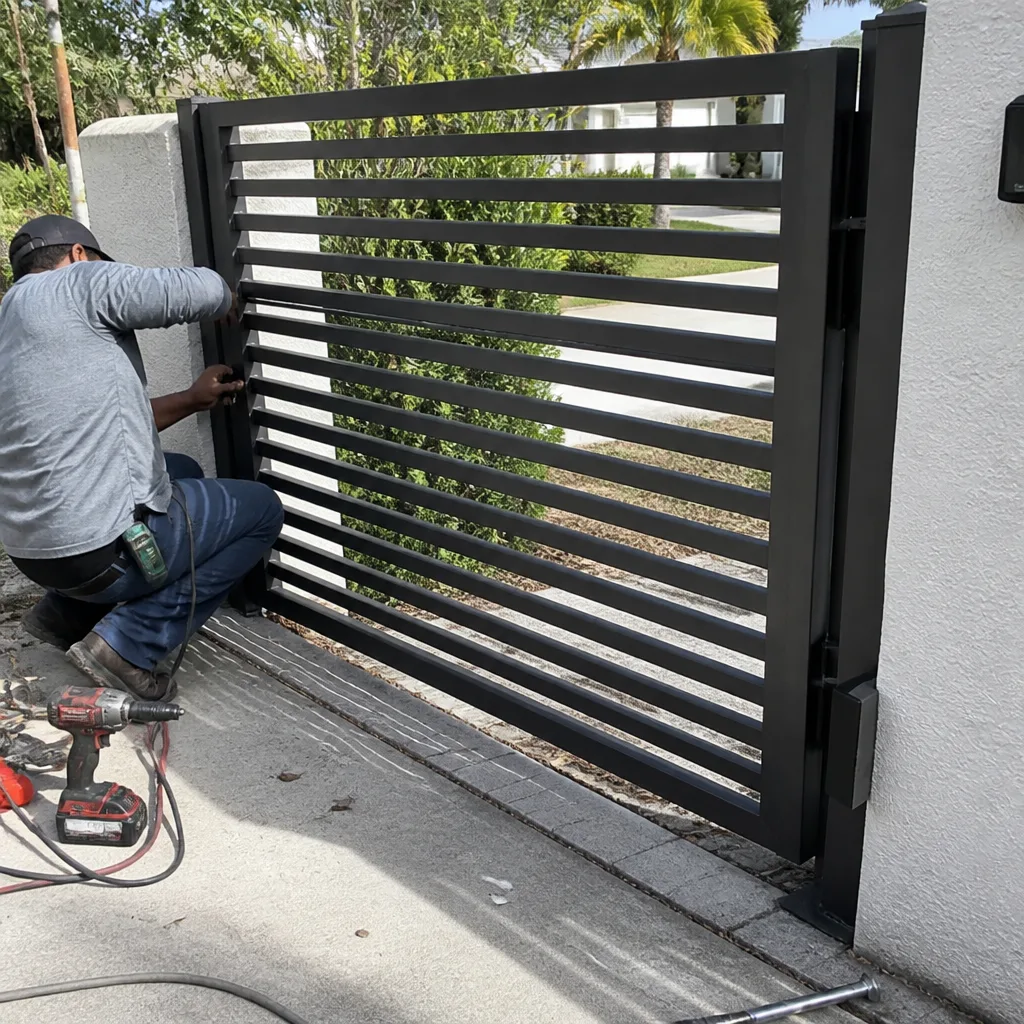
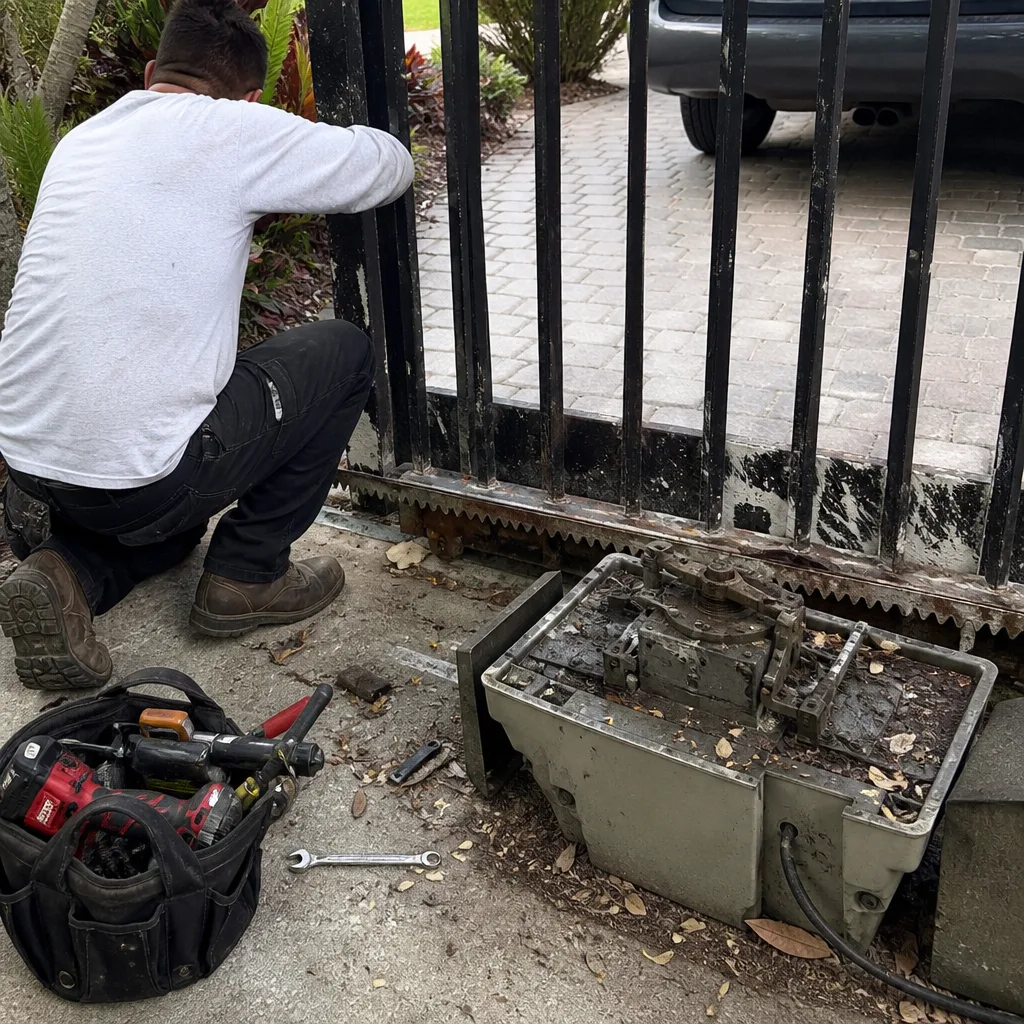
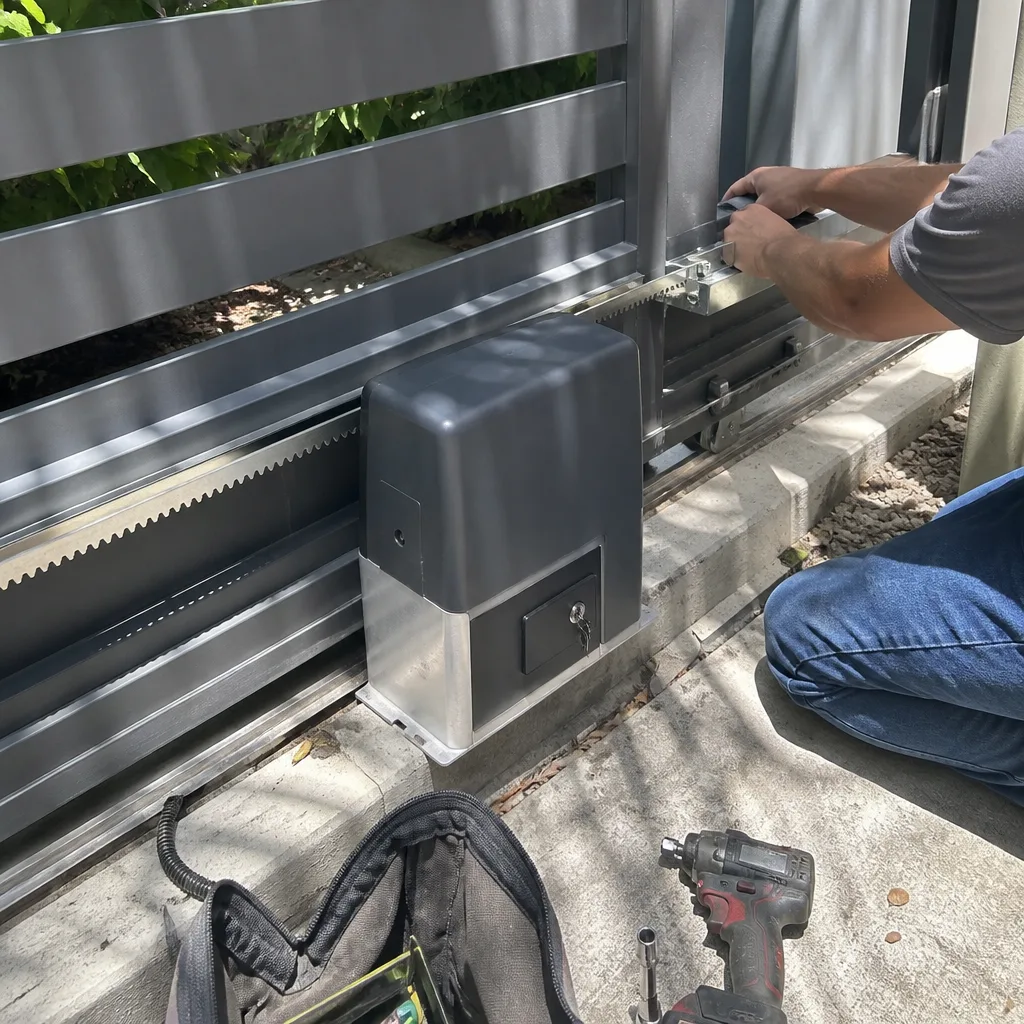
See the difference
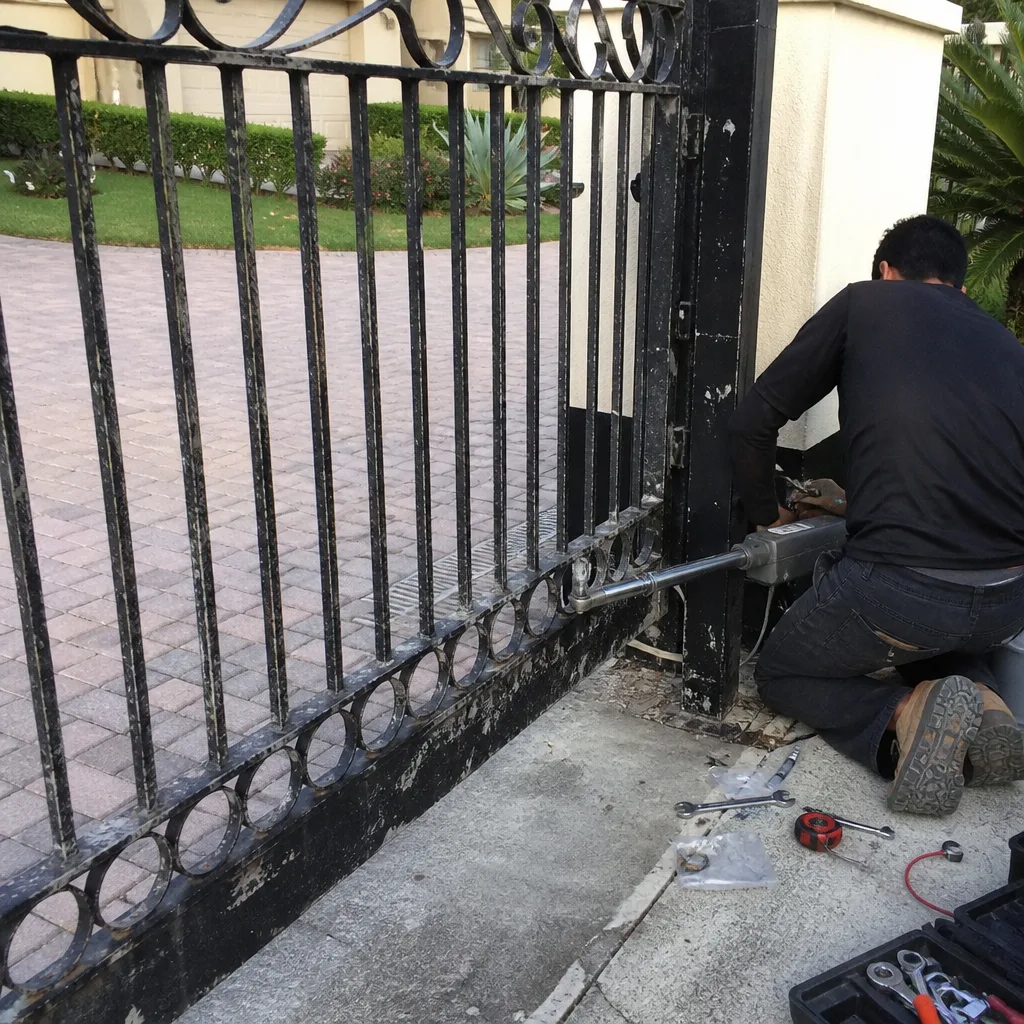 Before
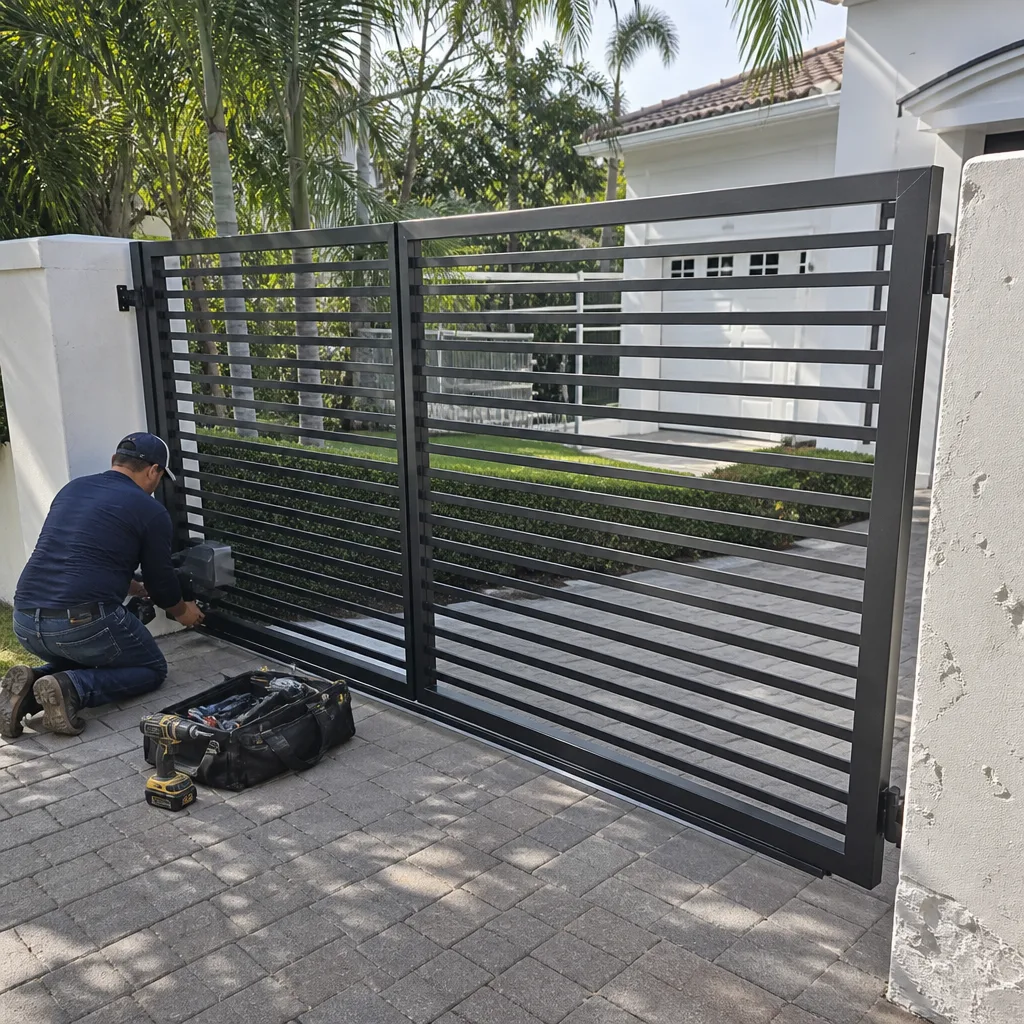 After
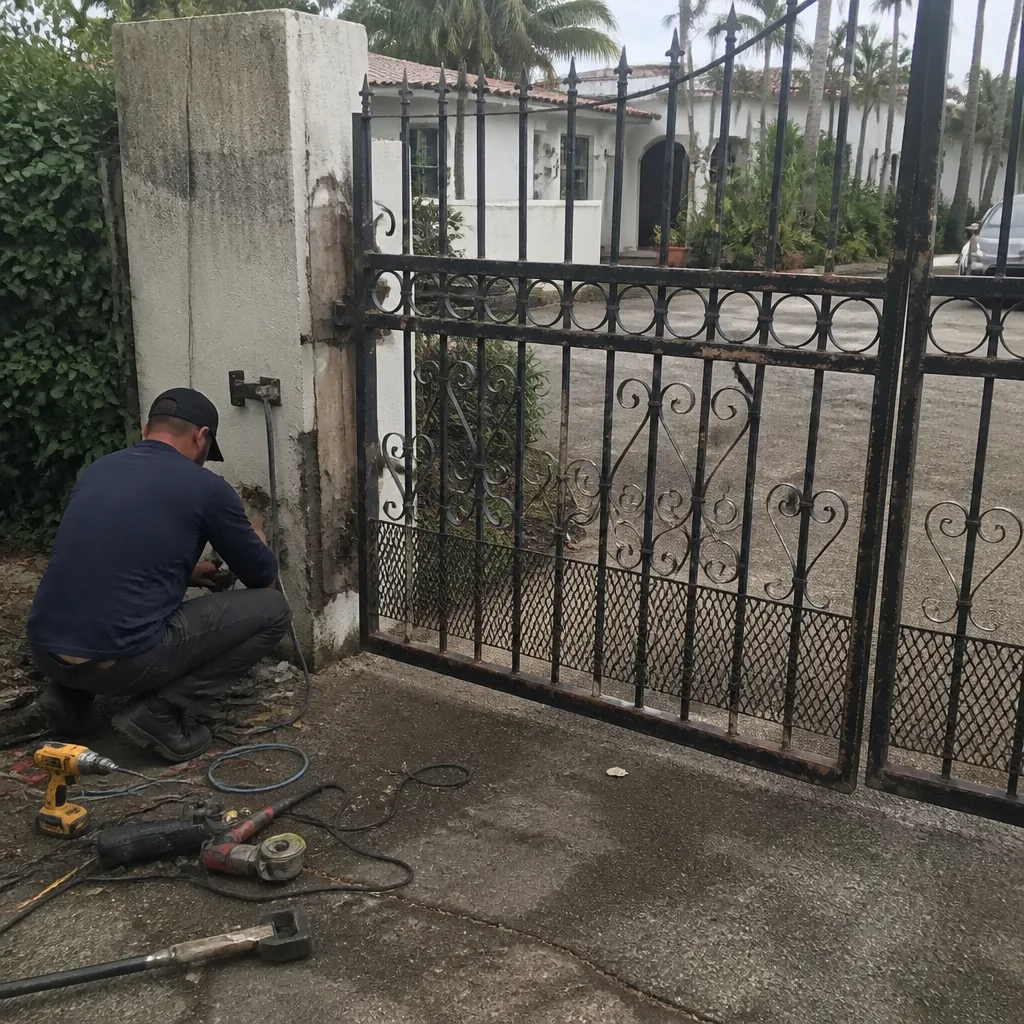 Before
 After
 Before
 After